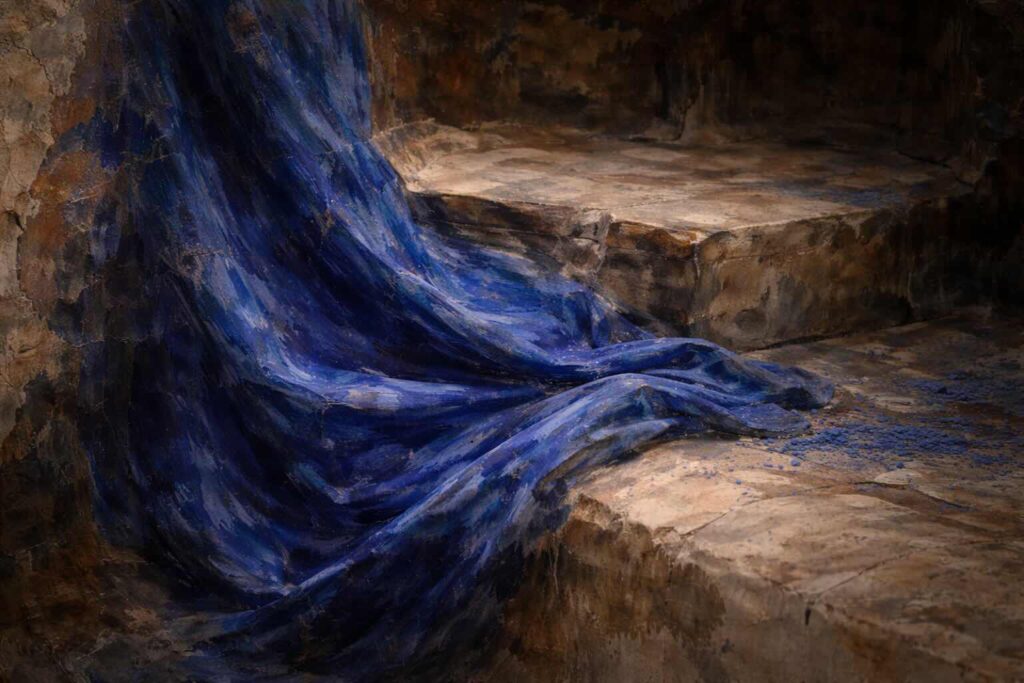
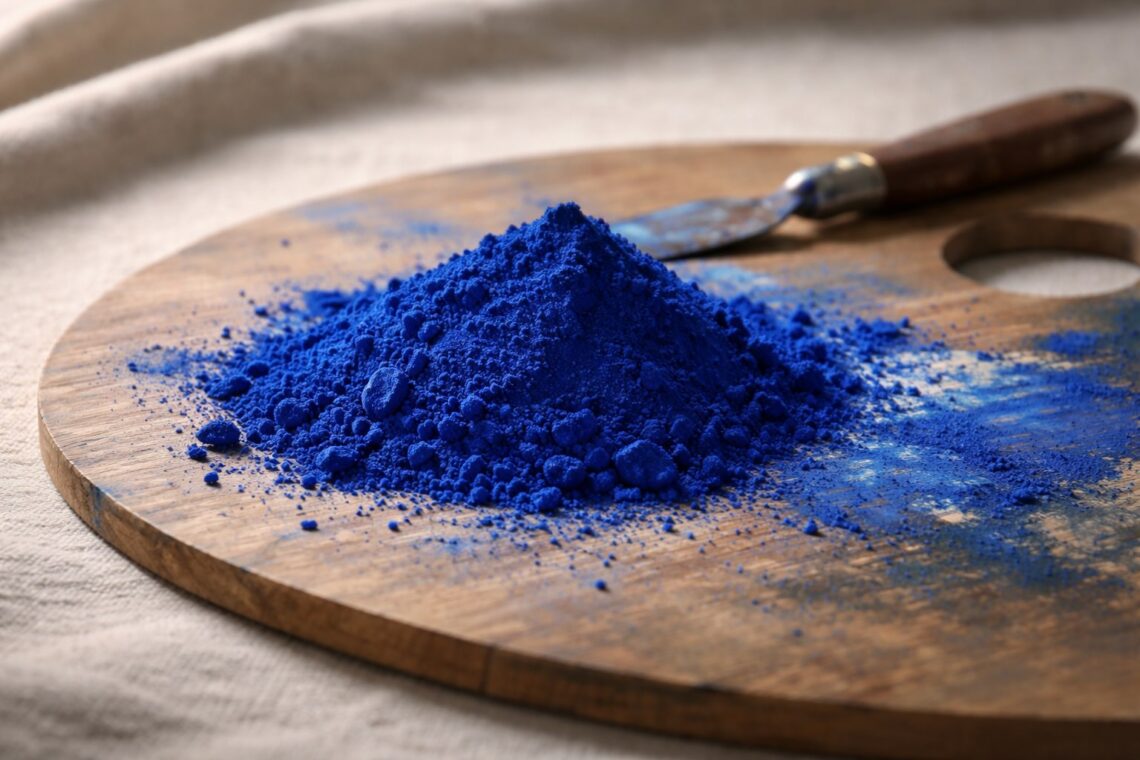
Ultramarine blue is one of the few colors in art whose value existed long before it touched a canvas. Painters did not discover it by mixing earth or plants. Artisans pulled it from stone. Natural ultramarine comes from lapis lazuli, a semi-precious rock mined mainly in the Sar-e-Sang region of Afghanistan. These mines have supplied artists for thousands of years, making them one of the oldest material sources in art history.
This origin alone sets ultramarine apart. It links painting to geology, trade routes, and time itself. Before becoming color, ultramarine was already rare, costly, and difficult to obtain.
Ultramarine Blue and Its Material Origin
Lapis lazuli does not appear blue at first glance. It is a complex stone made of several minerals. Only one of them, lazurite, creates the deep blue associated with ultramarine. Other minerals like calcite and pyrite interrupt the color and weaken its intensity.
If artisans simply crushed the stone, they produced a dull, grey-blue powder. True ultramarine required separation. That separation demanded skill, patience, and experience. Medieval pigment makers refined this process over generations, and Renaissance artists later documented it.
Cennino Cennini described the method in detail. Artisans crushed lapis, mixed it with beeswax, resins, oils, and gum, then kneaded it into a dense paste. They washed this mass repeatedly in warm water. With each wash, pure blue particles slowly released into the liquid. The first extraction produced the most intense and valuable pigment. Later washes yielded softer, weaker blues.
The yield remained extremely low. Large quantities of stone produced only small amounts of usable pigment. This scarcity was physical, not symbolic. It explains why ultramarine often cost more than gold.
How Ultramarine Blue Changed Painting Practice
Because of its cost, painters never used ultramarine casually. They planned its use carefully. Workshops treated it as a material of meaning, not decoration. Artists applied it late in the painting process, after establishing structure, form, and composition.
In Renaissance painting, ultramarine appeared where significance mattered most. Artists used it in sacred garments, skies, and figures of devotion. The Virgin Mary’s robe became its most famous home. Patrons often paid for ultramarine separately, and contracts specified exactly how much the painter could use.
Ultramarine also behaves differently from other pigments. It reflects light instead of absorbing it. This quality gives it depth without heaviness. Thin layers remain luminous. Multiple layers deepen the color without turning opaque.Painters learned quickly that ultramarine did not tolerate excess handling. Overworking dulled its brilliance. The pigment forced discipline. It required observation, timing, and restraint.
Ultramarine Blue and the Artist’s Hand
Ultramarine shaped how artists worked, not just what they painted. It slowed the process. It demanded decisions. Painters had to know when to apply it and when to stop.This relationship turned painting into a conversation between hand, pigment, and light. Artists did not dominate ultramarine. They responded to it. The color rewarded patience and punished haste.
When synthetic ultramarine appeared in the nineteenth century, the color became accessible. Synthetic versions look similar, but they behave differently. They lack the crystalline structure of natural ultramarine. They appear flatter and more uniform.For many painters, that difference matters. Museums still rely on natural ultramarine for restoration because it ages like the original material. It interacts with binders in the same way. Authentic works require authentic pigments.
Some contemporary artists still choose natural ultramarine today. They do not choose it for prestige. They choose it for control. The pigment slows them down and sharpens attention. Every stroke carries weight.
Why Ultramarine Blue Still Matters
In a world of instant images and unlimited color, ultramarine stands for something else. It represents time, effort, and material truth. It reminds us that painting is not only about expression. It is also about decision, care, and respect for the medium.
Ultramarine blue remains the most expensive color in the world for a simple reason. It demands more from the artist than most pigments ever will.